Sunday, January 26, 2014

As a bad day ends, wake up to a new tomorrow

We all have bad days.  This is especially true with chronic illness, like Multiple Sclerosis, as we encounter moments of pain, numbness, fatigue, spasticity and/or immobility. How on earth do we overcome these aching minutes, hours, days, months or, sometimes, all of our post-diagnosis lives?

I certainly don’t have the answer or a one-size-fits-all solution to offer up. But, I do believe there is something to remembering that with each breath is a new moment. That as a bad day ends, we will wake up to a new tomorrow, to a new day.

(c) C Germans Photography, 2011
Yeah, I wear rosy colored glasses. You caught me. I’m always drinking the proverbial glass-is-half-full.  This attitude, though, keeps me positive, remembering that bad days do not have to last forever. I was reminded of this while watching and listening to Shayne Koyczan (his video, "INSTRUCTIONS FOR A BAD DAY", is linked below). His spoken word in is truly a poetic reminder that bad days do come to close and that we can and should have hope for a better tomorrow.

I cannot pretend to know exactly what my fellow MSers go through on a regular basis - we’re all different. For me, feelings of loneliness and fear sometimes come up. This, plus enduring the physical symptoms of MS, can be difficult for me to manage. I am very hard on myself when I have bad days and I grow frustrated when my symptoms force me to rest or forgo something I was really looking forward to. I get pretty pissed off, angry to find that MS can limit my day(s). Yet, I try with all of my might to remember that the bad days don’t last forever. I try, try, try to wake up tomorrow morning with an open attitude, the chance to begin anew.

Does this make my symptoms disappear? Certainly no. But, trying to float up to a higher sense of optimism really helps. It’s so easy to fall into the despair that our symptoms can sometimes take us and I don’t want that for my life. I’ve got too much to do! So, while my symptoms may remain tomorrow, my attitude is certainly sprinkled with more positivity and shifts towards more hope for a better tomorrow.

"If you’re having a bad day…check your blind spot, love is still there" Shayne Koyczan, spoken word artist

And I don’t have to live through this alone, do I? Nor do you. Always remember that love and kindness are truly in your blind spot. Just remember to check it once in a while.  I say this because I sometimes have feelings of guilt when it seems like I am burdening my loved ones with my bad days. This makes me hold back, withdraw, and stop communicating about what I’m going through. During a recent and intense “bad moment” I checked over my shoulder and saw love, waiting for me. It’s been there all this time yet as I started wandering down that path of uncertainty and fear, I forgot and lost sight.

So, as I opened up, expressing my fears of a potential relapse (nope, not one, but still got scared) and what this could mean for the days and weeks ahead, I rediscovered how important love is during these moments. I was flooded with emotion and may have even released some tears (a rarity for me, I’m not a crier). A huge sense of relief came over me because I was reminded that I am not alone and found that the day-after-the-outburst was much, much better. I navigated the new day with a different, more positive perspective. A more hopeful one, no matter what showed up.

After all, I have to take the leap of faith that the next day will truly be better.

How about you? How, on your bad days, do you lift yourself up? Do you breathe in new moments or perhaps you’ve got another way to say goodbye to the bad day and hello to a new one. Would love to hear from you.

Best always, Christie

P.S. thank you Mr. Shayne Koyczan for giving me the opportunity to watch and listen to your words. You rock! 

P.P.S. listen to Shayne's words here: this-is-not-just-your-typical-pep-talk-or-instructional-video

Friday, January 10, 2014

Top 7 benefits of having pets in our MS life

Image courtesy of MultipleSclerosis.net
I recently jotted up a post on MultipleSclerosis.net about the benefits of having pets in our lives, specifically in our MS lives. Pets are truly wonderful as they help us cope, lift us from feelings of loneliness and depression and get us outside for a bit of sunshine and exercise. 

I’ve got a cat named Hans and he really makes a big difference, especially on the days I don’t feel good. He was my inspiration for the post, Woof, meow, tweet…the benefits of having pets in our MS life where I list the top 7 ways pets enrich our MS lives.

How about you? Do you have any stories about your pet(s)?

Best,
Christie

Tuesday, December 24, 2013

Coming Soon! True Champions video story

I recently had the pleasure, no wait…make that honor, of working with one of the fab crews over at HealthiNation, an online health video network. The team is producing a bunch of video feature stories, including some about MSers, as part of their “True Champions” series. The videos highlight folks advocating awareness of specific health conditions.

A producer, camera operator and sound tech hung out with us in sunny San Diego to shoot interviews, capture Team Luca riding and enjoying life in our neighborhood. Essentially, the whole point of the matter was to reflect that I am able to live a full life, one that is not defined by Multiple Sclerosis.

What an amazing experience! First, the crew was incredible and so very professional and mindful. My new pals were considerate of my energy, comfort and time as we created the material, frequently checking in with me to see if I needed water or just a break. And while I did wake up that morning battling fatigue, I informed the crew that I was okay because, as I shamelessly pointed out, “I’m on drugs. No, wait, as prescribed by my doctor. For fatigue, it’s nothing to worry about...I’m just a little amped up”. Yes, needless to say, I was pretty excited about participating in this project.


The day consisted of interviews and shots that highlighted my diagnosis, life with MS and My MS Manifesto. I tried to give Dr. Julie some serious cred here, as she is my inspiration, but found myself mispronouncing her last name. Nonetheless, we talked about the list of things I hope to do while living with MS, including laughing-laughing-laughing, jumping off the Stratosphere, riding my bicycle and working to lift up the MS community.

Now, I don’t want to give too much away because the video won’t be released until January but I will say it was a blast! At some point the camera operator was hanging out of the car window, armed with his camera, shooting Team Luca riding, yelling “Yeah! This is awesome!” So, stay tuned my friends.

Team Luca! Photo courtesy of HealthiNation
Oh, and the bonus? Even though I was battling fatigue all-day and endured some pain my leg, I got the chance to ride my bike. Yet another reminder that, when I ride, I am full of joy and bliss and forget that I am a person living with MS, if even for a few moments.

Best always,
Christie

Friday, December 20, 2013

Tysabri Infusion #21 (yawn)

The other day I had my twenty-first infusion of Tysabri and it was, again, another infusion without incident. The most exciting thing that happened for this 2-hour stay was the music played by all of the machines, beeping to let the staff know someone’s time with their drip was up. Beep, beep, beep. Beep, beep, beep.

Infusion without incident? Fine with me!
These monthly rounds are really getting boring and this is fine with me. I’m not looking for a ton of excitement when I’m hanging out in the infusion room, as the big T travels through my veins. It’s a standard, dull routine for me. Insert needle, Tysabri flows, I read a book, I dose off. Beep, beep, beep. Hour one is done. My nurse unhooks the bag, I read a book, I dose off. Beep, beep, beep. Hour two is done. I’m released and head home. Infusion without incident is the way it should flow, with no side effects or unbearable reactions.

The most exciting thing about my treatment thus far is the reason why I signed up for Tysabri in the first place– no new activity revealed on my last MRI, no relapses. Bam!

So, let the T flow. No excitement in the infusion room and no excitement on my MRI results? Perfectly fine with me.

Ciao for now.

Christie

Wednesday, December 11, 2013

Wordless Wednesday - Worrying

So, so true! I needed this reminder these last few weeks as I worried about some stuff. It took a while but I finally came to realize that worrying really stopped me from enjoying the good.

Friday, December 6, 2013

Take Care (Guest Post by Dan Digmann)

Note from The Lesion Journals: today's guest post comes from Dan Digmann. You can find Dan and his wife, Jennifer, over at http://danandjenniferdigmann.com to read their stories of how they have taken on MS, together.

"Take Care" by Dan Digmann

Mainstream news reports covering recent medical journal findings often make my wife, Jennifer, and me feel helpless.

Who can blame us?

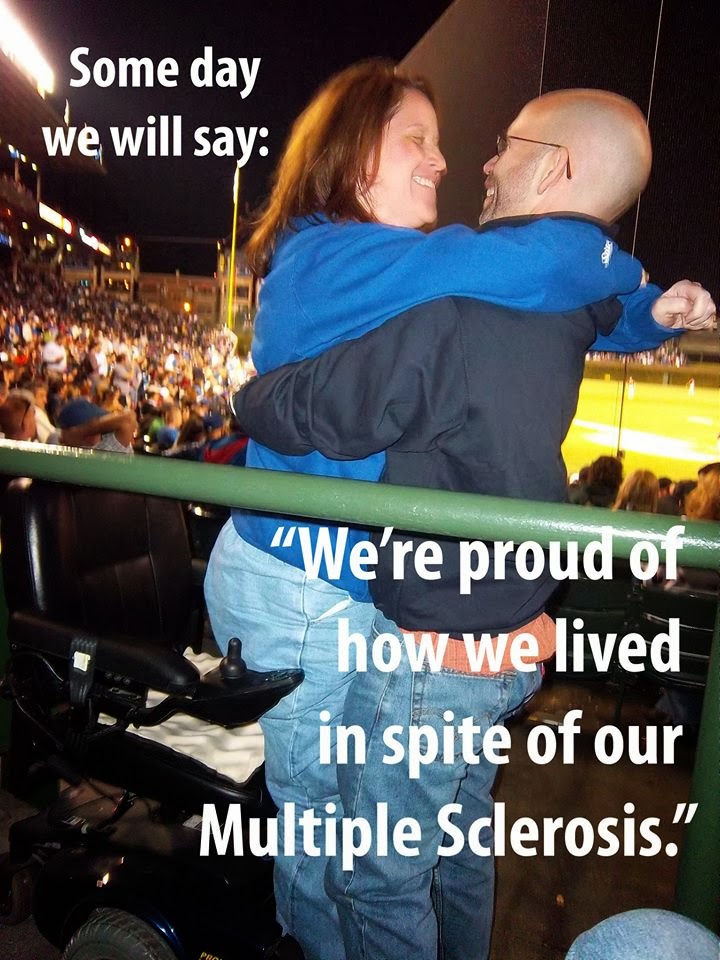
We’re a married couple. We both have Multiple Sclerosis (mine is relapsing-remitting; Jennifer’s is secondary-progressive). One of us is in a wheelchair. Oh yeah, and we each serve as the primary caregiver for the other.


So when ABC Nightly News with Diane Sawyer reported earlier this year that recent research showed the key to good health and reducing the risk of heart disease is walking each day, we actually wrote the network to ask what they suggested a person in a wheelchair should do.

We’re still waiting to hear back.

We’ve been well aware of studies linking the stress of caregiving for a chronically ill family member to increased mortality rates ever since we got married on Sept. 10, 2005. Perhaps our wedding vows would have been better stated with, “In sickness and, uh, in sickness.” 

But the MS couldn’t deter us from getting married. After all, we met at a National MS Society event and knew what we were getting into with this stupid disease we share.

Needless to say, we still are beside ourselves with what Medical News Today reported in the middle of October. According to its story Family caregiving linked to longer life expectancy, “A new US study led by Johns Hopkins researchers contradicts long-standing beliefs that the stress of caregiving leads to early death and instead shows that family caregivers live around 9 months longer than non-caregivers.”


Imagine that: encouraging words from a mainstream news report on research findings! The story indicates that the results are available online in the current issue of American Journal of Epidemiology, and it in part states that, “… many of the caregivers reported increased self-esteem and receiving gratitude and recognition from the family members they cared for.”

Seems to make sense, doesn’t it? So often when it comes to MS, people focus on the needs for things like medications, adaptive equipment or programs to help the person living with the disease improve his or her quality of life. It is interesting to note, then, that something as simple as showing gratitude and recognition can have such a positive impact on improving the quality of life for the MS caregiver

There is further information in the Medical News Today story that points out the study doesn’t necessarily paint a complete picture of the entire caregiving process and that further research is needed. But it’s worth repeating that the research itself  “… shows that family caregivers live around 9 months longer than non-caregivers.”

Imagine if the key to increased longevity is as simple as caring and showing gratitude. What an easy way to improve everyone’s quality of life.

Dan

http://www.despitemstospitems.com/
For more inspiring essays from the Digmans,
check out their book. A part of the proceeds
goes towards the Nat'l MS Society.
http://danandjenniferdigmann.com

Thanks for stopping by Dan and cheers to you and Jennifer. Happy Holidays!

Tuesday, December 3, 2013

Break Barriers, Open Doors - Top 5 ways to observe IDPD2013

Did you know that about 15% of the world’s population lives with some kind of disability? Whoa. That means more than 1 billion people are facing all kinds of barriers: physical, social, economic and attitudinal. According to the UN, we are disproportionately represented among the world’s poorest and lack equal access to basic resources in education, employment, healthcare, social and legal situations. Yet, we have remained largely invisible. Crazy, right?

As a person born with some loss of hearing, I’ve always tried to be an equal participant in the world as I believe I can do anything that a person with full hearing can do. As you might guess, not hearing everything can be limiting and, coupled with a recent diagnosis of Multiple Sclerosis, I have needed and have asked for additional resources to keep working, to keep playing, to keep living the life I want to live. In my little world, I try to break down the barriers as best I can.
At home, I added Closed Captioning to the TV set so I can get every word uttered during the latest episode of Modern Family (this turns out to be funnier than intended because sometimes those folks typing out the actor’s lines really get it wrong). At work, I’ve asked for small but mighty powerful tools to help me do my job effectively. After all, it is very important be on an equal playing field with my colleagues. At play, I’ve added things to my bicycle to help see well. This is especially important because I totally love to ride my bicycle as fast as possible and I don’t want a case of flaring optic neuritis to get in my way!

These are just a few examples and upon realizing that the world is embarking on another International Day of Persons with Disabilities (IDPD) on December 3, 2013, I thought to broaden and expand this list of breaking barriers and share my Top 5 ways to observe this important day.

As you read the list, I invite you to think about these key words today, featured on the UN website, as we continue to break barriers and open doors: include, organize, celebrate and take action.

Top 5 ways to observe IDPD2013:
  • Consider using different language. When communicating, try to put the person first, not their disability. Use “person with disability” not “disabled person”, in your conversations. This slight change focuses on a person’s individuality and empowers. For more positive phrases, check out the ODEP website.
  • Stand up! In the United States, we who live with some kind of disability do have rights, especially in the workplace (hence, “reasonable accommodation”) and it’s important to ask for the tools needed to be effective. Through my employer, I was able to get a Pocket Talker to help hear better during large meetings and other goodies that have made a huge difference.
  • Strengthen your independence. Reach out to local and state agencies, such as the Department of Rehabilitation, for assistance. I was able to get a really groovy alarm clock that shakes my bed awake with a buzzer that I place in my mattress. It’s so cool.
  • Celebrate! If you know someone who has made a contribution in breaking down barriers and opening doors, let’s celebrate them!
  • Chat about this important day. Send tweets, update your Facebook page or take a photo to share on Instagram. Use the following hashtags #IDPD2013, #thisability, and #IDPD on your pages and status updates. For example, you could send a tweet as follows: “I'm supporting this year's International Day of Persons with Disabilities #thisability #IDPD.

So, as we clink glasses to commemorate another IDPD, let’s strive for ways to focus on the inclusion of disability in all aspects of our lives, on the basis of human equality.

Cheers!


P.S. check out this rad stamp of Chuck Close! The United Nations General Assembly (UNPA) selected artists with incredible stories that “…highlight the positive power of full and equal participation of peoples with disabilities.” 

Celebrating an incredible story!


Sources:

United States Department of Labor, ODEP (Office of Disability Employment Policy): http://www.dol.gov/odep/pubs/fact/comucate.htm

You Might Also Like: